Tuesday, March 17, 2026

Fact Guardian | Inside US Politics & World Affairs
Fact Guardian | Inside US Politics & World Affairs
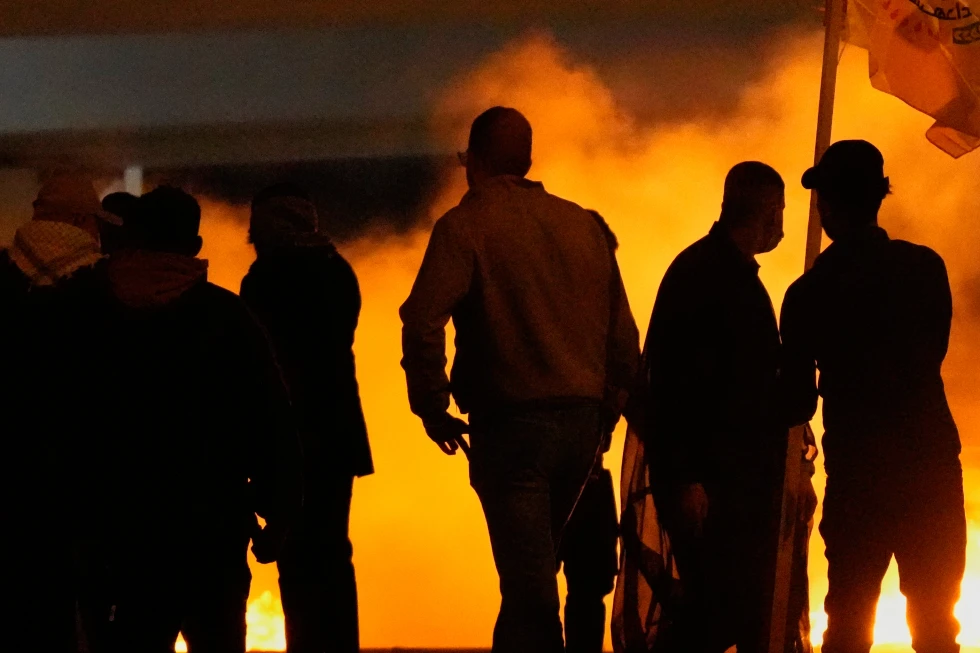
Security forces fire tear gas to disperse a protest against U.S. and Israeli attacks on Iran, at a bridge leading to the fortified Green Zone where the U.S. Embassy is located in Baghdad, Sunday, March 1, 2026.
WASHINGTON — As the United States and Israel strike Iran in a growing conflict, the Trump administration is facing an apparently unanticipated crisis as a result of the largest U.S. diplomatic withdrawal in the Middle East since the start of the Iraq War more than 20 years ago.
Despite the war closing major airports and causing widespread flight cancellations, the State Department has been compelled to close several embassies to the public, close at least one consulate, order the departure of embassy staff and families from at least six countries, and advise Americans in 14 countries to leave the region immediately.
The department did, however, report on Tuesday that over 9,000 Americans had returned safely from the Middle East since the weekend, many of them without government support, and that it was actively helping those who had requested assistance, including by securing charter flights and military aircraft.
Secretary of State Marco Rubio told reporters, "There have been a few instances where we have planes in the air and on the way, and unfortunately, the airspace gets closed, and they have to turn back around."
Dylan Johnson, assistant secretary of state for public affairs, stated on X that the department has communicated with around 3,000 Americans who wish to leave the area or are looking for advice on how to do so.
Speaking on Capitol Hill before informing members of the most recent events, Rubio said that 1,500 people had genuinely asked for assistance in departing.
There were plans to arrange charter planes from the United Arab Emirates, Saudi Arabia, and Jordan. According to the department, it is planning land travel to nations with flights, such as Egypt and Oman, in those where airports or airspace were closed.
However, the ability to provide what would normally be considered ordinary aid to U.S. citizens in need has been severely strained by emergency reductions in embassy staffing and post closures since the strikes on Iran started over the weekend. Many locations, including Bahrain, Jordan, Kuwait, Lebanon, Pakistan, Qatar, and Saudi Arabia, lack consular services, and staff reductions have hindered important official interactions with ally and partner nations during the conflict.
The extent of the American withdrawal from the area is comparable to, if not greater than, that which was carried out in the lead-up to and immediately following the 2003 invasion of Iraq. At the time, the State Department cut staff in over a dozen nations and encouraged Americans to leave or give leaving countries in the Middle East, North Africa, and South Asia—from Morocco to Pakistan—some serious thought.
In a hurriedly written statement published on X on Monday, Americans were instructed to depart Bahrain, Egypt, Iran, Iraq, Israel, Jordan, Kuwait, Lebanon, Oman, Qatar, Saudi Arabia, Syria, the United Arab Emirates, and Yemen despite the disruptions to commercial flights and other modes of transportation.
The State Department had ordered non-essential diplomats and embassy families to depart Bahrain, Iraq, Jordan, Kuwait, Qatar, and the United Arab Emirates, Americans were informed early Tuesday.
On Tuesday, the public was not allowed to enter the embassies in Saudi Arabia, Jordan, Kuwait, or Lebanon. However, the U.S. consulate in Karachi, Pakistan, was the only diplomatic facility to fully halt operations.
According to Saudi Arabia's Defense Ministry, a drone attack on the American Embassy in Riyadh resulted in a "limited fire."
According to an internal State Department cable, the strike in Riyadh resulted in the collapse of a portion of the embassy's roof, but no staff members were killed or injured. It stated that two drones struck the area around the embassy in Kuwait City, but no one was killed or injured.
Confusion was spreading throughout the area, prompting concerns about the State Department's main duty of preparing for any military action and how it might affect travel and American safety abroad.
According to Shawn VanDiver, president of AfghanEvac, a group that assists Afghan nationals wishing to enter the country after serving with American forces in Afghanistan, "if Americans are being told to leave but are given no viable pathway, that suggests one of two things: The system is not being activated or the system has atrophied."
He pointed out that the Biden administration had coordinated the evacuation of 121,000 people in a few days during the 2021 U.S. pullout from Afghanistan.
He declared, "Crisis response cannot be partisan." It must withstand changes. It has to be preserved, staffed, and exercised. The oversight question is simple: Has the framework for responding to crises since Afghanistan been strengthened or maintained?
A question concerning the State Department's preparations for staffing embassy and consulates and aiding U.S. citizens in the event of a conflict with Iran was not immediately answered.
American citizens cannot be forced to leave any country by the U.S. government. In certain rare cases, it may render the use of U.S. passports for travel to a certain location unlawful. Only North Korea is subject to such restrictions. However, Rubio stated Friday that the ban might potentially apply to Iran prior to the start of the strikes.
State Department travel advice, such as warnings not to travel to or leave a nation, is frequently disregarded. Many people who live there or have close relatives there choose not to follow the advise.
The Middle East is home to a sizable population of American residents and visitors. However, as Americans are not obliged to declare their presence in any other nation, the State Department declines to provide an estimate. Any estimate would be erroneous, it says.
It's estimated that tens of thousands of Americans, many of whom hold dual citizenship, reside in Egypt, Iran, Israel, and Lebanon.

Paul L. Mayer covers the intersection of politics, and financial policy, with a focus on how global and regional developments shape markets and everyday life.