Tuesday, February 24, 2026

Fact Guardian | Inside US Politics & World Affairs
Fact Guardian | Inside US Politics & World Affairs
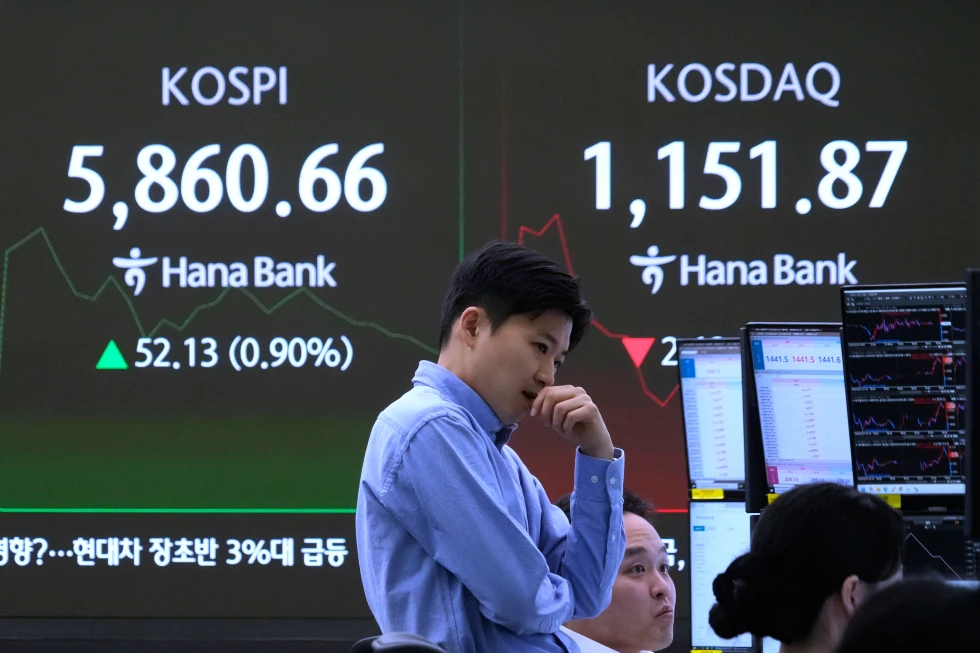
A currency traders reacts near a screen showing the Korea Composite Stock Price Index (KOSPI), left, and the foreign exchange rate between U.S. dollar and South Korean won at the foreign exchange dealing room of the Hana Bank headquarters in Seoul, South Korea, Monday, Feb. 23, 2026.
BANGKOK —Following the Supreme Court's decision to overturn the majority of President Donald Trump's expansive tariffs, U.S. futures fell and global markets were neutral on Monday.
Tariffs are not going away in spite of the decision. Trump declared on Friday that he would impose import taxes by alternative means, including an executive order that imposed a 10% worldwide duty, which he later increased to 15%. He stated that he is considering further levies, including those that would necessitate inquiries from the Commerce Department.
Officials from the Trump administration stated that they expect other nations to follow trade agreements based on the rescinded tariffs. However, given the uncertainties surrounding his future actions, the response to the most recent revelations has been hesitant.
In a blog, Benjamin Picton of Rabobank stated that the conflicting responses are "highlighting the winners-and-losers effect of shifts in tariff policy that has just delivered a boost to countries who previously had a comparatively bad deal."
As traders try to factor in the effects of what is still a moveable feast, "U.S. tariff policy will continue to be a source of uncertainty for markets," he wrote.
Early on Monday, Bitcoin fell as much as 5%, falling below $65,000, but it eventually regained around half of that loss. Investors withdrawing from speculative assets and worries about future bitcoin regulation have been the main causes of the sell-off.
Touted as "digital gold," the original cryptocurrency has dropped over half of its value since reaching a record high of $126,210.50 on October 6.
The Paris CAC 40 remained steady at 8,515.65, while Germany's DAX dropped 0.5% to 25,137.69. At 10,685.10, the British FTSE 100 was likewise essentially unchanged.
The Dow Jones Industrial Average's future fell 0.3%, while the S&P 500's lost 0.2%. The Nasdaq composite index saw a 0.3% decline in the future.
China's mainland and Japan's markets were closed on holidays.
Hong Kong's Hang Seng index jumped 2.5% to 27,081.91, leading the region in advances.
The Kospi in South Korea increased by 0.7% to 5,846.09.
The S&P/ASX 200 in Australia fell 0.6% to 9,026.00.
India's Sensex was up 0.6%, while Taiwan's Taiex climbed 0.5%. Bangkok's SET came to a near-empty conclusion.
Following the Supreme Court's decision against the tariffs, which had caused financial markets to panic when they were announced last year, Wall Street remained composed on Friday. The Nasdaq composite increased by 0.9%, the Dow by 0.5%, and the S&P 500 by 0.7%.
Relatively nothing was said in response to depressing figures released Friday that showed increasing inflation and declining U.S. economic growth.
Despite highlighting the Fed's interest rate quandary, the reports did nothing to alter traders' estimates of the Fed's final course of action. According to CME Group data, traders continue to wager that the Fed will cut rates at least twice this year. Although lower interest rates would enhance investment prices and the economy, they also run the danger of making inflation worse. At their most recent meeting, Fed members stated that they would not support further rate cuts until they saw inflation continue to decline.
U.S. benchmark crude oil dropped 33 cents to $66.15 a barrel in other transactions early Monday. The global benchmark, Brent crude, dropped 34 cents to $70.96 a barrel.
The value of the US dollar dropped from 154.94 to 154.85 Japanese yen. From $1.1797 to $1.1799, the euro gained value. While the price of silver increased by 5.2%, the price of gold increased by 1.8%.

Daphne W. Cooper focuses on Entertainment trends, analyzing how business, sports, and market developments affect regional and global economies.