Tuesday, March 17, 2026

Fact Guardian | Inside US Politics & World Affairs
Fact Guardian | Inside US Politics & World Affairs
The Chinese company AutoFlight, founded in 2017, developed the Matrix, which can carry up to 10 passengers. It has a 20-meter (about 66 foot) wingspan, and is 17.1 meters long and 3.3 meters tall. (56 feet long and 11 feet tall). It can travel for an hour without charging. The idea is that eventually it could become a flying taxi, although the industry and experts think it will take some time
PARIS —This metropolis in southeast China offers a preview of what flying taxis may look like in the future.
A sort of enormous drone was getting ready for a display in a hangar in Kunshan, more than 60 kilometers (about 37 miles) west of the port of Shanghai. The 5-ton electric vertical takeoff and landing vehicle, or eVTOL, known as the Matrix, is regarded as the biggest electric aircraft ever constructed, at least in China.
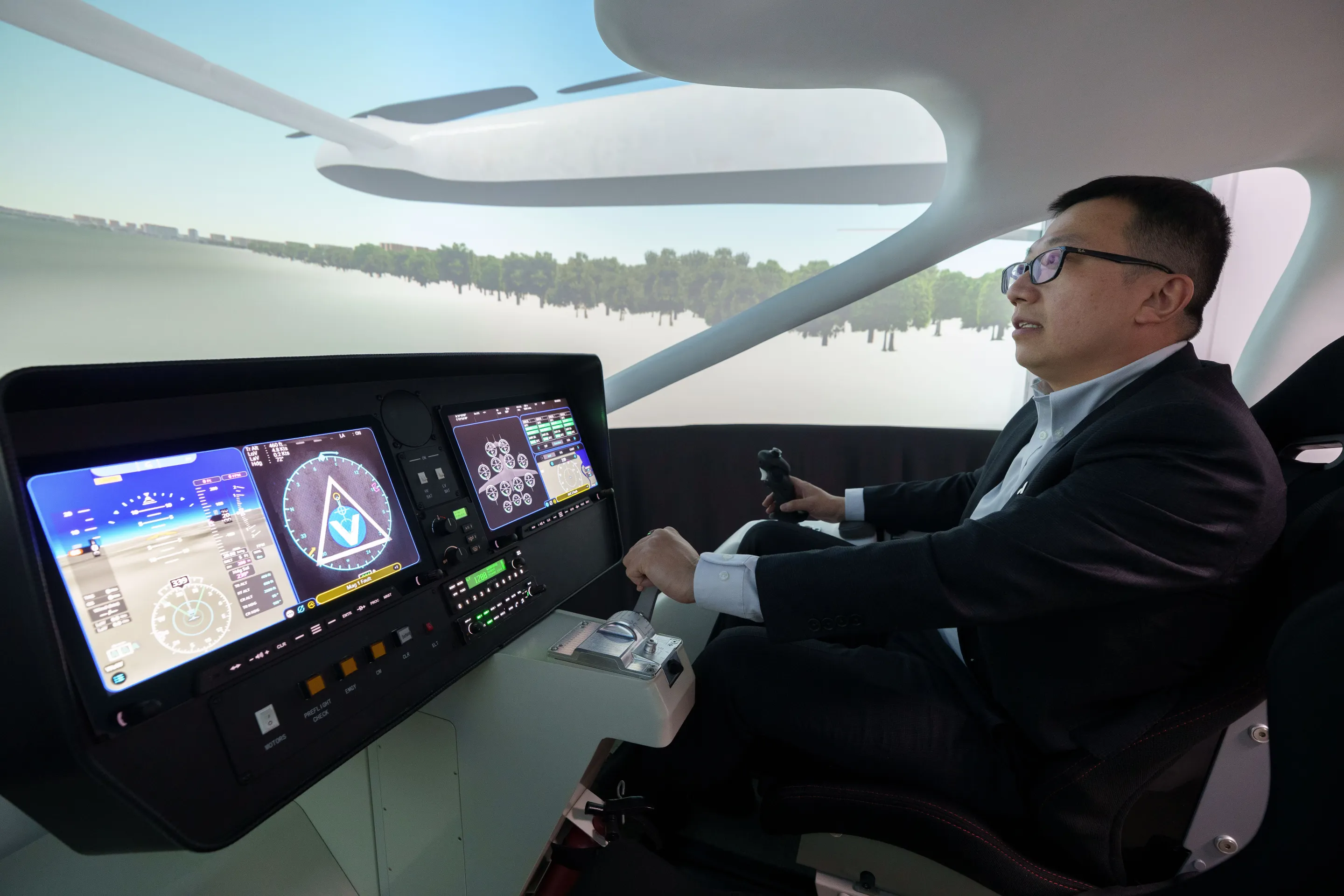
The Matrix, which can accommodate up to ten passengers, was created by the Chinese business AutoFlight, which was established in 2017. It is 17.1 meters long, 3.3 meters tall, and has a wingspan of 20 meters, or roughly 66 feet. (11 feet tall and 56 feet long). Without charging, it has an hour of travel time.
Although experts and the industry believe it will take some time, the concept is that it may someday become a flying taxi.
At its low-altitude flight test facility, AutoFlight recently performed a flying demonstration for The Associated Press on a cold afternoon.
After a few minutes of making sure everything was functioning properly and turning on the propellers, the eVTOL was ready to rise. Though not as loud as a helicopter, it was nevertheless noisy. After two laps around the heliport and around ten minutes later, the Matrix returned and made a trouble-free landing.
When will it be possible to fly taxis? A few years? More?
Steven Yang, senior vice president of AutoFlight, stated, "This is a good question, but it is very difficult for me to answer."
Although it is awaiting the necessary certifications, the business already has a 2-ton passenger eVTOL variant.
According to Yang, AutoFlight intends to receive a type certificate from authorities by 2027, which would attest to the aircraft design's compliance with safety regulations. However, an operator certificate that permits the aircraft to transport passengers would still need additional regulatory clearances.
Other Chinese businesses are also producing eVTOL planes. Authorities have already certified EHANG, located in Guangdong province, to provide commercial passenger services. That hasn't yet occurred. Flying taxis require facilities to operate, therefore aside from permissions, they are not yet cruising the air.
Drones are already being used to distribute food as part of what is referred to as the "low-altitude economy," as seen in Shenzhen, a city in southern China.
Senior economist Gary Ng of Natixis Corporate and Investment Banking has tracked the sector's growth. He stated that China must overcome a number of obstacles, including as ensuring safety, constructing the necessary infrastructure, and organizing logistics like routing.
He added, "At this time, the entire ecosystem that surrounds the technology itself is still underdeveloped." "I think something more feasible won't appear for at least another three years."
It appears that such planes can be seen in the skies when watching the Matrix demonstration. But is it realistic to think that flying electric aircraft will be a thing in the future?
"We firmly think it will occur," Yang stated. "But the entire ecosystem is responsible for this, not just AutoFlight," he continued.
__

Daphne W. Cooper focuses on Entertainment trends, analyzing how business, sports, and market developments affect regional and global economies.